Q. 10 Which is having higher breakdown strength? (FPSC 2018) (AXEN)
a. Solid dielectrics
b. Liquid dielectrics
c. Gases dielectrics
d. all having equal
Ans is a) Solid dielectrics
Solution: A good dielectric is one that have low dielectric loss and high mechanical strength. These shall be free from gaseous inclusion, moisture and be resistant to thermal and chemical deterioration. Solid dielectrics have higher breakdown strength compared to liquids and gases.
When breakdown occurs, solids get permanently damaged while gases fully and liquids partly recover their dielectric strength after the applied electric field removed.
Solid dielectrics are paper, mica, ceramic and glass, etc… Liquid dielectrics are oil used in transformer, distilled water, etc… Gase dielectrics are metal oxides, nitrogen, helium, etc…
Dielectric Strength is defined as the maximum electric field that a material/substance can withstand without experiencing failure of its insulating properties.
It is measured in megavolts per meter (MV/m). The higher the Dielectric Strength, the better a material is to prevent electrical conductivity.
A perfect vacuum is actually the best electrical insulator. A perfect vacuum has the highest dielectric strength, rated at 1×10¹² MV/m. A perfect vacuum contains no material to breakdown and is, therefore, the perfect electrical insulator. In reality, a perfect vacuum is nearly impossible to achieve but a high vacuum is also a great insulator, rated at 30 MV/m. High vacuums are used as an insulation method in equipment like vacuum circuit breakers.
Q.11 With the same secondary voltage and filter, which has the most ripple? (NESCOM)
a. Half-wave rectifier b. Full-wave rectifier c. Bridge rectifier d. Impossible to say
Ans is a) Half-wave rectifier
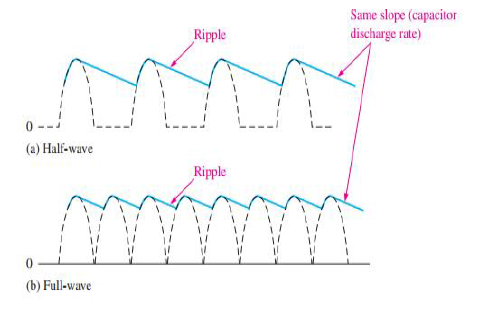
Solution: For a given input frequency, the output frequency of a full-wave
rectifier is twice that of a half-wave rectifier,which makes a full-wave
rectifier easier to filter because of the shorter time between peaks.
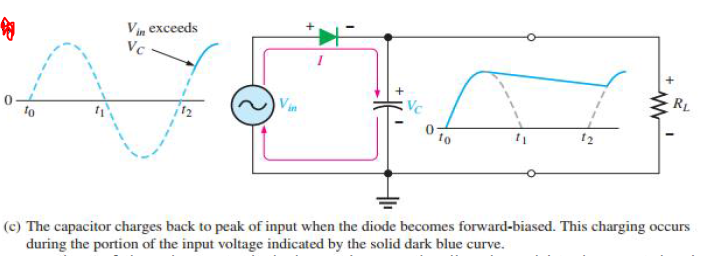
When filtered, the full-wave rectified voltage has a smaller ripple
than does a half-wave voltage for the same load resistance and
capacitor values. The capacitor discharges less during the shorter
interval between full wave pulses, as shown in Figure
Q. 12 A 15 V source is connected across a 15 resistor. How much energy is used in three minutes? (NESCOM)
a. 75 Wh b. 0.75 Wh c. 90 Wh d. 0.90 Wh
Ans is b). 0.75 Wh
Solution: As we know that
P=V2/R = (15)2/15 =15 w
Time = 3 minutes = 3/60 hours
Energy= Pt = (15 *3)/60 = 3/4 =0.75 Wh
OR
I= V/R=15/15=1 and P=I2R =(1)2(15)=15 w
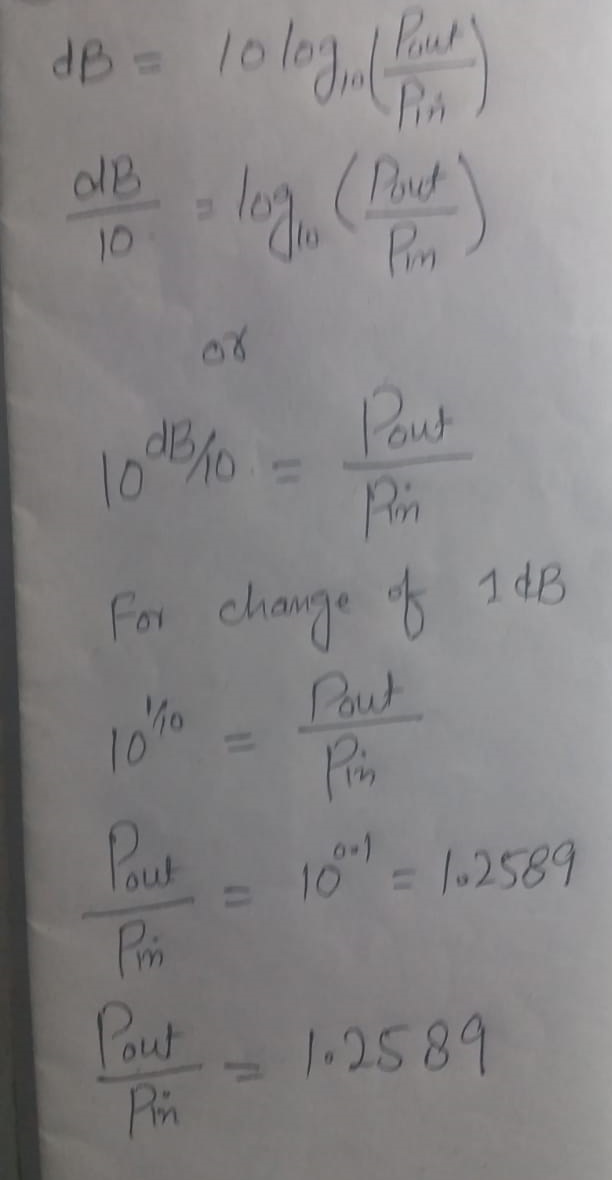
Q. 13 1 dB corresponds to _______ change in voltage or current level
a. 40% b. 80% c. 12% d. 25%
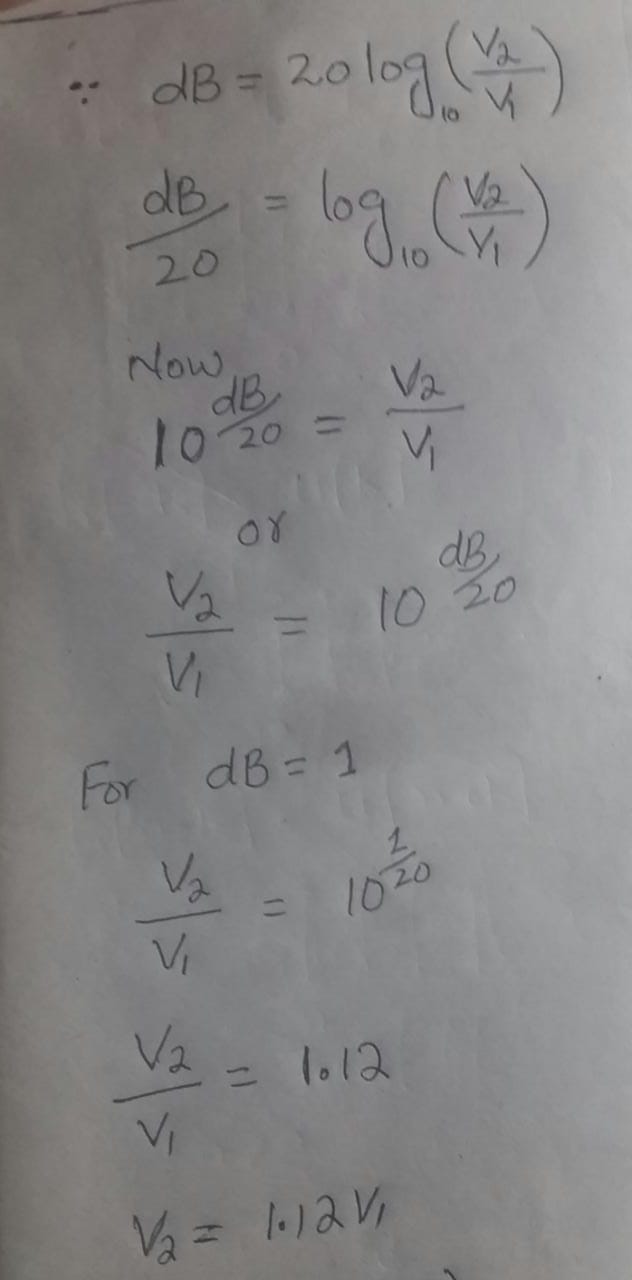
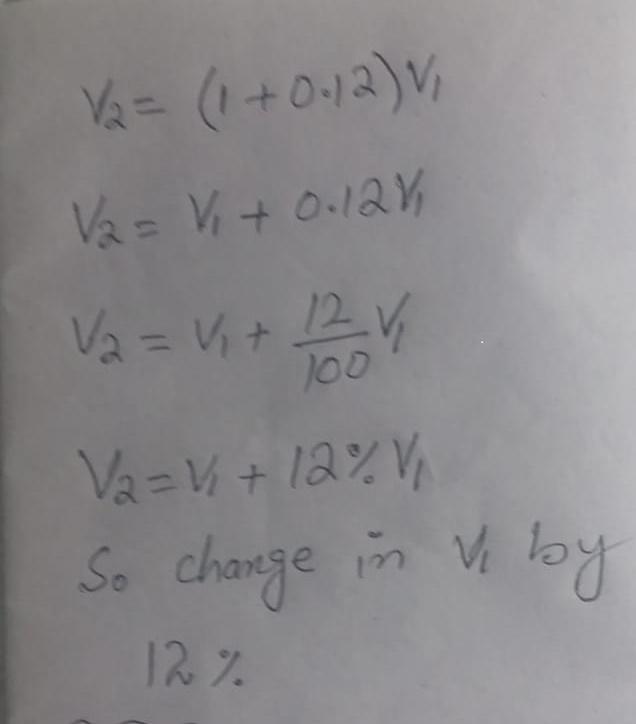
Ans is c). 12%
Solution:
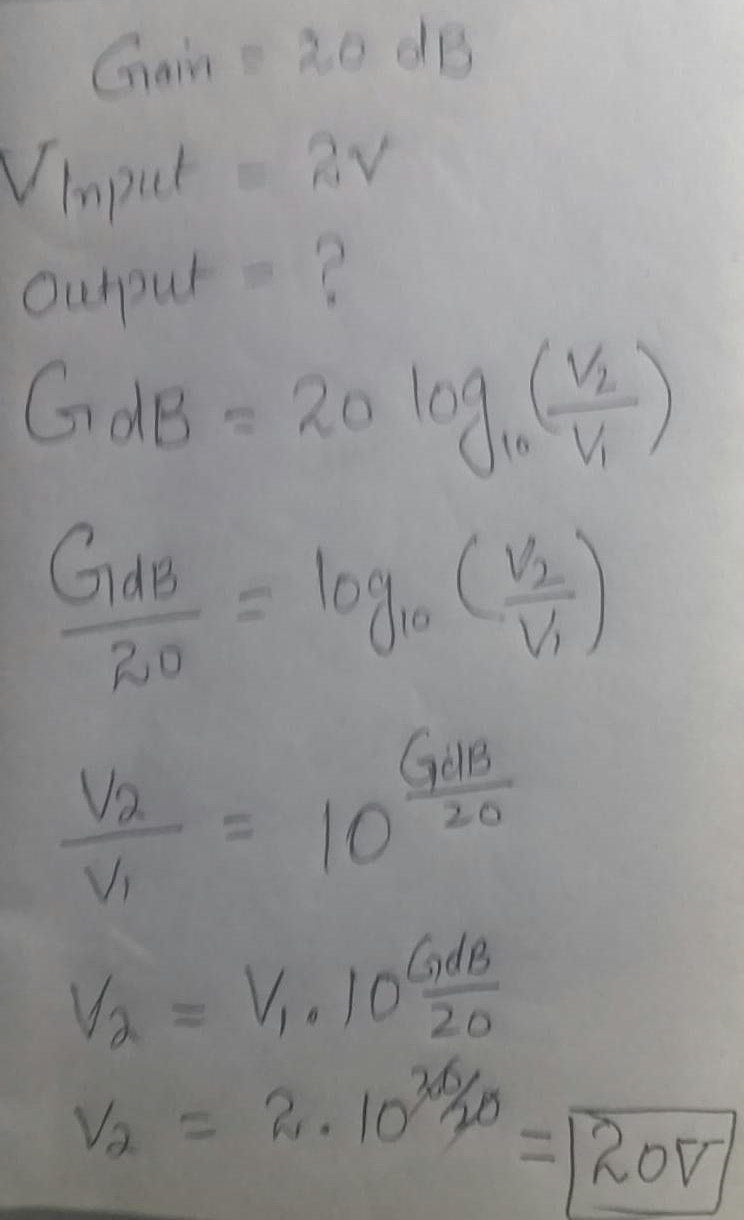
Q.14 A power amplifier has a gain of 20 dB and an input level of 2 volts. Assuming that the input and output impedances are the same, what is the voltage level at the amplifier output?
a. 10 V b. 20 V c. 30 V d. 40 V
Ans is b). 20 V
Solution:
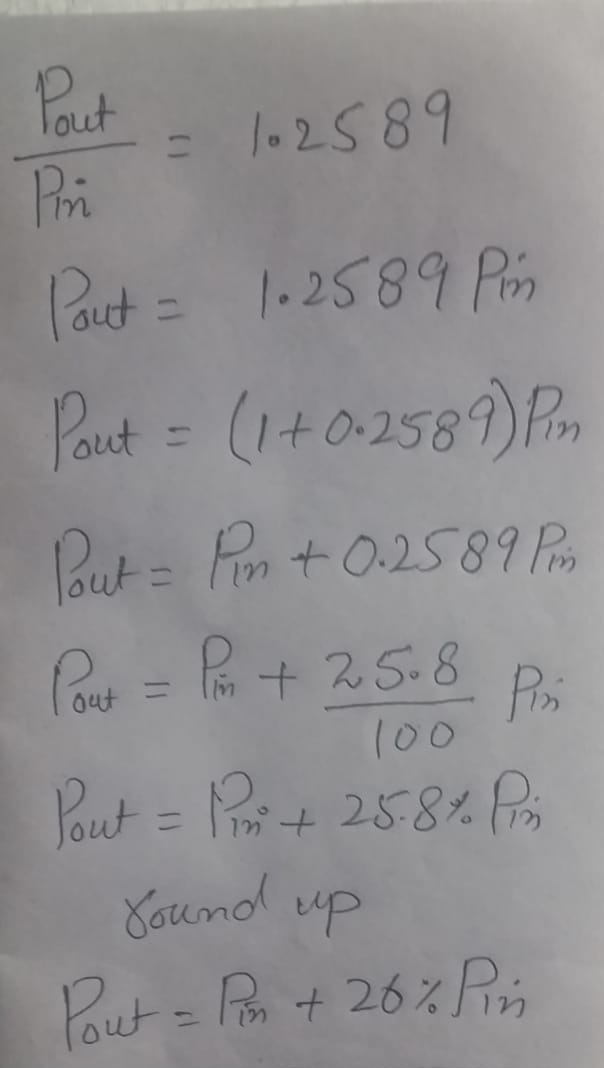
Q. 15 1 db corresponds to_________ change in power level
a. 50% b. 35% c. 26% d. 22%
Ans is c). 26%
Q.16 A heater is rated as 230 V, 10 kW, A.C. The value 230 V refers to__________?
a. average voltage
b. r.m.s. voltage
c. peak voltage
d. none of the above
Ans is b). r.m.s voltage
In electrical power system, the voltage used for the rating of appliances is r.m.s voltage. It is defined as peak voltage divided by the square root of two. OR
RMS stands for Root-Mean-Squared, and is equivalent to a DC voltage that would provide the same amount of heat generation in a resistor as the AC voltage would if applied to that same resistor. it is also called the effective or heating value of alternating current.
Q.17 Full wave rectifier with 50 Hz input frequency has output frequency_________
a. 50 Hz
b. 100 Hz.
c. 75 Hz
d. None of the above
Ans is b). 100 Hz
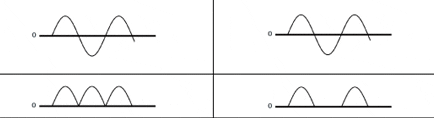
A full-wave rectifier rectifies both cycles of the AC input i.e., it conducts two times during one cycle. The output frequency is Twice/double that of the input frequency. Therefore the output frequency of a full-wave rectifier is 2 x 50 = 100 Hz.
The Image here shows that the output of Full wave rectifier has 3 cycles for input of 1.5 cycles.
Q.18 The apparent power drawn by an A.C. circuit is 10 kVA and active power is 8 kW. The reactive power in the circuit is
a. 4 kVAR
b. 6 kVAR
c. 8 kVAR
d. none of these
Ans is b). 6 kVAR
Figure below show the Power Triangle. It shows the relationship B/W apparent power, active and reactive Power.
So we know that
(apparent power)² = (active power)² + (reactive power)²
(Reactive Power)2= (Apparent Power)2 -(Active Power)2
10² – 8² = (reactive power)²
100 – 64 = (reactive power)²
36 = (reactive power)²
reactive power = 6 kw
Q.19 The system 2d2y/dt2+4dy/dt+8y=8x, has damping ratio______
a. 0.25
b. 0.1
c. 0.33
d. 0.5
Ans is d. 0.5
The given System is a second order system and is given by
2d2y/dt2+4dy/dt+8y=8x
After taking the Laplace Transform we get
2s2Y(s)+4sY(s)+8Y(s)=8X(s)
or
(2s2+4s+8) Y(s)=8X(s)
Y(s)/X(s) =8/(2s2+4s+8)
so, the transfer function of the system is
T(s)=Y(s)/X(s) =4/(s2+2s+4)
comparing with a general second Transfer function
T(s)= ωn2 / (s2+2ζωn s+ωn2
ωn2 =4 so ωn=2
2ζωn=2, so ζωn=1 and ζ=1/ωn =1/2=0.5
So the ans is 0.5.
 The Image here shows that the output of Full wave rectifier has 3 cycles for input of 1.5 cycles.
 So we know that