As power systems around the world transition to renewable energy sources, grid stability has become one of the biggest challenges. Traditional generators provided inertia, reactive power support, and fault current contribution. With renewables like solar PV and wind (which use power electronics), these services are reduced. That’s where synchronous condensers come into play—an old technology making a comeback in the modern grid. in this Post we will provide a comrehensive understanding on the Role of Synchronous Condensers in Modern Power Systems (2025)
Synchronous Condenser
A synchronous condenser (or synchronous capacitor) is essentially a synchronous motor running without a mechanical load.
- It consumes a small amount of active power (to overcome losses).
- By adjusting excitation, it can generate or absorb reactive power.
- Provides inertia to the grid like conventional generators.
In simple terms: A synchronous condenser works like a generator that doesn’t generate active power, but stabilizes the grid.
Excitation conditions for synchronous condensers
- Under-excitation (low DC excitation): The synchronous condenser absorbs reactive power from the grid (acts as an inductive load).
- Over-excitation (high DC excitation): The synchronous condenser supplies reactive power to the grid (acts as a capacitive load).
Our Most Read Posts
- Inside a 380kV BSP: Overall Layout Drawing Explained
- 380kV Gantries & Gantry Equipment
- List of Contractors who Won Major BSP Projects in 2024 in KSA
- Tower Testing in Power Transmission: A Complete Guide
- Top Electrical Engineering Courses on Coursera
- List of Top Substation contractors in KSA
- Vector Group of Transformers
- Top Excel Functions Every Engineer Should Master
Challenges in Renewable-Dominated Grids
Following are the main Challenges in Renewable-Dominated Grids
Lack of Inertia:
- Conventional power plants (e.g., coal, gas, nuclear) use large rotating generators that provide inertia to the power system. This inertia helps stabilize grid frequency by resisting sudden changes in demand or generation.
- Renewable sources like wind and solar don’t have such large rotating masses (or have much smaller ones in the case of wind turbines). As a result, these sources provide little to no inertia to the grid. Without enough inertia, the grid becomes more vulnerable to frequency fluctuations during sudden load changes or disturbances (like faults or short circuits).
Lack of Reactive Power:
- Traditional synchronous generators inherently generate reactive power alongside active power, which helps maintain voltage stability.
- Renewable energy sources (like wind turbines and solar PV inverters) typically operate using power electronics, which lack the inherent ability to provide reactive power unless they are specially designed to do so. This results in a deficiency of reactive power, which can lead to voltage instability in the grid.
Role of Synchronous Condensers in Modern Power Systems (2025)
1. Reactive Power Support (Voltage Control)
SCs generate or absorb reactive power, which helps maintain grid voltage within acceptable limits. When there is a demand for more reactive power, synchronous condensers can supply it, and when there is too much, they can absorb it. This is critical for voltage control in a renewable-heavy grid, where conventional generators that usually provide reactive power might not be present.
- Over-excited mode → generates reactive power (supports voltage).
- Under-excited mode → absorbs reactive power (controls overvoltage).
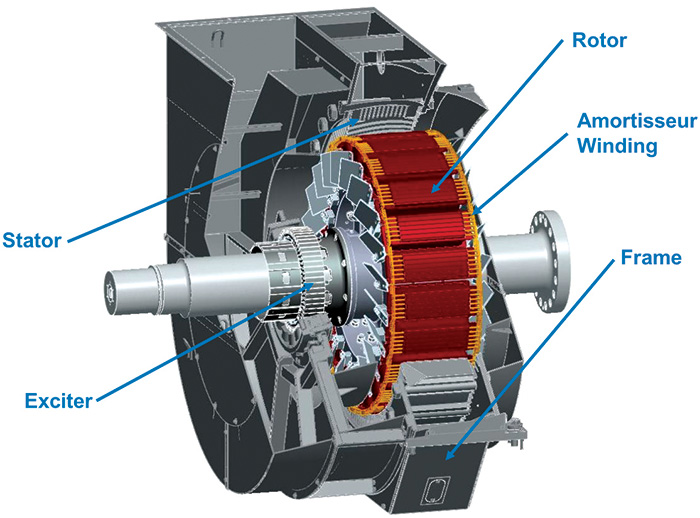
2. Short-Circuit Power & Fault Contribution
- SCs also contribute to the short-circuit power of the system. This is particularly important because fault levels in a power system must remain above a certain threshold to ensure that protection systems (like relays and circuit breakers) operate properly.
- In a grid with fewer conventional generators, the overall short-circuit level may be reduced, which can make it harder for protective devices to detect and clear faults. SCs help raise the short-circuit power contribution, ensuring that fault conditions are properly handled.
- Provides short-circuit currents, which are important for relay operation and system protection.
3. Inertia for Frequency Stability
Synchronous condensers are essentially large rotating machines that add inertia to the grid. This inertia helps buffer the system against sudden frequency changes caused by variability in renewable generation. For instance, if there’s a sudden dip in solar power output due to cloud cover, the SCs’ inertia slows down the rate of frequency change, giving system operators more time to respond.
- Unlike inverter-based renewables, synchronous condensers have rotating mass.
- Helps resist sudden frequency deviations (grid “shock absorbers”).
4. Harmonic Filtering & Power Quality
- Improves stability of weak grids by damping oscillations.
Applications in Modern Grids
- Renewable-Dominated Networks: With solar/wind replacing traditional plants, synchronous condensers compensate for missing inertia.
- Weak Grids: Regions with low short-circuit strength use them to strengthen the grid.
- HVDC & Interconnectors: Installed at converter stations to provide reactive support and short-circuit contribution.
- Large Substations: Often placed at 400kV / 380kV bulk supply points for voltage stability.
Advantages
- Provides both dynamic reactive power and inertia.
- More reliable than capacitor banks (no switching transients).
- Can operate continuously with minimal maintenance.
- Extends life of grid assets by improving voltage stability.
Limitations
- Higher capital cost compared to static devices (capacitor banks, STATCOM).
- Requires cooling and maintenance.
- Occupies space and consumes some active power.
🔹 Real-World Example: Saudi Arabia & GCC
In the Gulf region, grid stability is critical due to:
- High penetration of renewables (Saudi Vision 2030).
- Long transmission distances (desert environment).
- High demand growth.
That’s why utilities are increasingly considering synchronous condensers at 380kV substations to strengthen weak points in the network.
🔹 Conclusion
Synchronous condensers may seem like old technology, but they are proving to be a key enabler of modern power systems. By providing reactive power, inertia, and fault support, they ensure that grids remain stable, secure, and reliable in the renewable era.
For electrical engineers, understanding their design, operation, and applications is now essential—especially in regions like Saudi Arabia, where the grid is rapidly evolving under ambitious energy transition plans.