Vector Group of Transformers, indicates the phase relationship also called phase difference (angle shift) between the High Voltage and Low Voltage windings. It tells you how the windings are connected (star or delta) and the phase displacement between them. This is important for ensuring proper synchronization and operation in power systems.
This is our 6th post that is part of Extra High Voltage EHV Substation Design & 380kV Substation Design. If you are new on our website it is recommended to read first the below Posts
- 380kV Gantries & Gantry Equipment
- Inside a 380kV BSP: Overall Layout Drawing Explained
- 380kV Gas-Insulated Switchgear (GIS)
- Power Transformers
- Auxiliary Transformer Sizing for a 380kV BSP
Vector Groups in Transformers Key Concepts
Winding Connections:
- Star (Y) Connection: All three windings are connected at a common neutral point.
- Delta (Δ) Connection: Windings are connected in a triangular loop.
- z: Zigzag connection
- N → neutral is brought out
- a → Autotransformer
Phase Displacement:
- The LoW voltage can be shifted in phase relative to the High voltage.
- This shift is measured in 30-degree increments (e.g., 0°, 30°, 180°, 330°).
Notation:
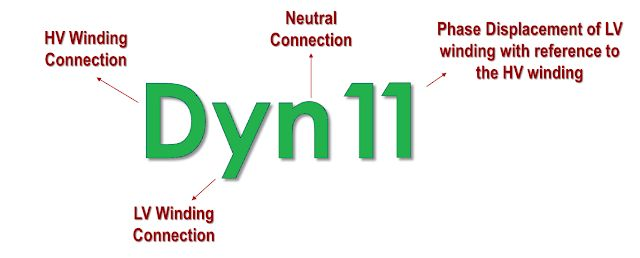
- Vector groups are represented by symbols like Dy11, Yy0, Dd0, Yz1 etc.
- The first letter indicates the High Voltage HV winding connection (D for Delta, Y for Star).
- If D/d or Y/y is followed by N it means that winding neutral is brought out and available for connection
- a is used for auto transformer.
- The second letter indicates the Low Voltage LV winding connection.
- The number (0, 1, 2, 11, etc.) represents the phase displacement in multiples of 30°.
Reference IEC Standard for Vector Groups
IEC 60076-1 is the first part of the IEC 60076 series, titled “Power Transformers – Part 1: General.” It establishes the fundamental principles, requirements, and test procedures for power transformers, ensuring their safe, reliable, and efficient operation in electrical power systems. The standard applies to three-phase and single-phase power transformers (excluding certain special types like traction transformers or instrument transformers). Below is the scope of this standard
- Applies to liquid-immersed and dry-type transformers.
- Covers transformers with rated voltages above 1 kV and rated frequencies up to 60 Hz.
- Includes requirements for:
- Winding connections (e.g., star, delta).
- Vector groups.
- Insulation levels.
- Temperature rise limits.
- Short-circuit withstand capability.
- Noise levels.
- Environmental considerations.
Example of Vector Group: Dy11
- HV Winding: Delta-connected (D).
- LV Winding: Star-connected (y).
- Phase Displacement: 330° (30° lag).
- Application: Commonly used in distribution transformers to reduce harmonics.
Example of Vector Group: YNa0d1
- Y → HV winding connected in Star
- N → HV neutral is brought out
- a → Autotransformer (common winding between HV and LV)
- 0 → 0° phase displacement between HV and LV (same polarity)
- d → Tertiary winding connected in Delta
- 1 → Tertiary winding has 30° phase displacement
Related posts you may like
- Main Components of Substation-Power Transformers
- Most Common Electrical engineering interview questions
- Top Electrical Engineering Courses on Coursera
- List of Top Substation contractors in KSA
- Transmission Line Design Important Points
- Panels required inside substations
- Electrical MCQs with Explanation of Answers
- Electrical Past papers
- How to Add MCQs in wordpress posts
- Transmission Lines design Basics