Electrical Standards, Codes & Safe Work Procedures · Part 1 of 6
A supplier quotes a 400 V auxiliary switchboard for a Saudi substation and writes “IEC 61439 compliant” on the datasheet. The tender also references the Saudi Electrical Code, a utility specification and a single-line diagram. Can the engineer accept the offer based on that one line?
The compliance statement answers one part of the review. The engineer still needs to know which edition the supplier used, what evidence covers the offered assembly, and whether its ratings and interfaces meet project requirements. The installation and the procedures for working on it require their own checks.
1. What is the difference between an electrical code and a standard?
An electrical code establishes requirements within a defined scope. Its legal effect depends on how the jurisdiction adopts or applies it, including any local amendments. A code can also be referenced in a contract.
An electrical standard gives technical requirements, tests or engineering methods for a particular subject. A standard can become binding through a regulatory reference or a contract. Start with its scope, edition and the document that calls it up.
A project specification sets client requirements for ratings, service conditions, submittals and acceptance. A safe work procedure defines how authorized personnel manage hazards during a particular task at a facility.
| Document type | Question it answers | Typical evidence |
|---|---|---|
| Electrical code | What requirements apply to the installation? | Design drawings, calculations and inspection records |
| Product standard | How is the equipment designed and verified? | Design verification evidence and routine verification records |
| Engineering guide | What method is used for an assessment? | Study model, documented inputs and results |
| Client or utility specification | What must this project deliver? | Compliance matrix, datasheets and approved submittals |
| Site procedure | Who may perform the task and which controls apply? | Approved work plans, permits and records |
2. What do SBC 401, NEC, IEC, IEEE and NFPA 70E cover?
| Reference | Scope and example |
|---|---|
| SBC 401 | Saudi building electrical systems, including wiring, grounding and distribution panels. Check it for the substation control building’s electrical installation where applicable. |
| NFPA 70 / NEC | Electrical installation requirements. Check wiring methods, grounding and bonding, or overcurrent protection where the governing documents invoke the NEC. |
| IEC 60364-1 | Fundamentals for low-voltage electrical installations where the project specifies this framework. |
| IEC 61439-1 and IEC 61439-2 | General rules and specific requirements for applicable low-voltage power switchgear and controlgear assemblies. |
| IEC 62271-200 and IEC 62271-203 | Part 200 covers AC metal-enclosed switchgear above 1 kV through 52 kV. Part 203 covers gas-insulated metal-enclosed switchgear above 52 kV. |
| IEEE 1584 | Calculation methods for arc-flash incident energy and arc-flash boundary within the guide’s scope. |
| NFPA 70E | Workplace electrical safety practices for managing personnel exposure. |
Why NFPA 70 and NFPA 70E both appear on electrical projects
The installation review may cover cable routing, grounding and bonding, access and overcurrent protection. A later maintenance intervention raises questions about authorization, electrical hazards and safe work controls. An applicable IEEE 1584 study can provide arc-flash results for some of those decisions. The operating team assesses the task and follows the site’s approved procedures.
3. Which requirements apply to a Saudi substation?
A single substation package may cover primary switchgear, a control building, auxiliary AC and DC supplies, protection panels and equipment interfaces. Divide the package into systems and map each system to the applicable requirements.
| Scope | First documents to check | Review question |
|---|---|---|
| Control building electrical installation | SBC 401, applicable amendments, approved design and project requirements | Do installed wiring routes and bonding arrangements match the approved design? |
| LV auxiliary switchboard | Project specification, approved single-line diagram and specified assembly standard | Does the assembly evidence cover the offered configuration and service conditions? |
| 13.8 kV metal-enclosed switchgear | Applicable IEC 62271 standard, utility specification and datasheet | Does the offer meet the required switching duties, withstand and interlocking? |
| 380 kV GIS | Applicable GIS product standard, utility specification and datasheets | Do the ratings and evidence address specified insulation levels, interfaces and site conditions? |
| Maintenance and switching | Asset owner’s safety rules and approved operating procedures | Who controls and verifies the work boundary? |
For an SEC or National Grid SA tender, record the specification numbers and revisions cited in the tender package against each item. See our SEC standards update for examples of utility document naming and our substation tendering and contract management guide for the bid review context.
4. Worked example — reviewing a 400 V auxiliary switchboard offer
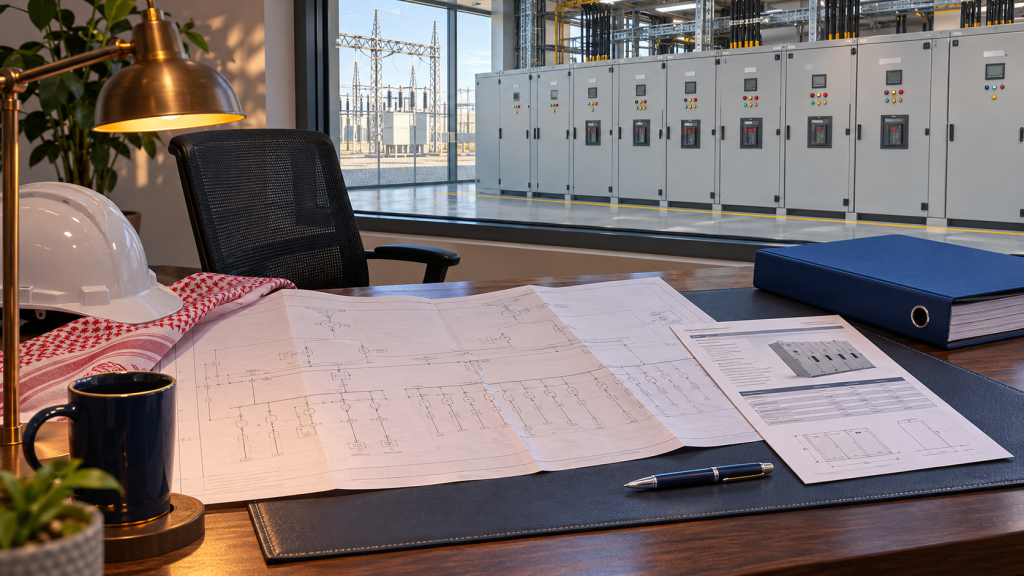
The project documents specify a switchboard short-circuit withstand requirement. The vendor submits a breaker interrupting rating and states that the panel complies with IEC 61439. Review the device rating, assembly capability, verification evidence and installation interfaces before accepting the offer.
Check the assembly and breaker ratings separately
The breaker interrupting rating describes the device’s ability to interrupt a fault under its rated conditions. The assembly’s short-circuit capability concerns the offered switchboard as a system, including its busbars, supports and associated components. Ask the supplier for the applicable assembly rating, any conditions tied to a specified protective device and evidence covering the configuration. Compare these against the project fault study and specification.
Match the evidence to the offered configuration
Changes to the enclosure, busbar arrangement or major components can require the manufacturer to demonstrate that existing design verification covers the change. Identify the design verification evidence to review during submittal and the routine verification records to require for the delivered assembly.
Check installation interfaces before freezing the price
Compare the vendor’s general arrangement with the approved building layout and single-line diagram. Check cable entry, termination space, access, bonding, control supplies and alarm signals. Confirm the specified service conditions and any dependencies on room cooling or ventilation. Clarify who supplies cable glands, support steelwork and external wiring.
Record the result in a compliance matrix
| Item | Requirement source | Evidence to request | Example status |
|---|---|---|---|
| Assembly standard and edition | Project technical specification | Manufacturer’s declaration and supporting design verification | Offered edition to be confirmed |
| Short-circuit capability | Fault study and switchboard specification | Assembly rating, duration or protective-device conditions as applicable, and evidence | Breaker data received. Assembly evidence pending. |
| Cable entry and termination | Approved layout and cable schedule | Dimensioned drawing showing entry and termination details | Under layout review |
| Routine verification | Inspection and test plan and applicable assembly standard | Verification records for the delivered assembly | Review at the specified inspection stage |
| Controls and indications | Control schematic and signal list | Terminal schedule and interface drawings | External alarm interface to be confirmed |
5. What if the tender references conflicting requirements?
Check whether the references address the same equipment, condition and edition. If the difference remains, record both references, the technical issue and its impact on equipment selection, cost or schedule. Seek formal clarification through the designated client or design authority and carry the response into the compliance matrix and RFQ.
Sample clarification — The switchboard specification and the equipment datasheet reference different assembly short-circuit requirements. Kindly confirm the required assembly rating and duration, or any applicable protective-device conditions, for vendor selection and pricing.
Frequently asked questions
Can an IEC-compliant panel satisfy a Saudi building project?
It can form part of a compliant installation. Check the exact IEC standard, edition, configuration and evidence. Also review the installed system against the Saudi building-code and project requirements that apply.
Does the NEC automatically apply to every Saudi electrical project?
Check the jurisdictional and project documents to establish if they reference the NEC, which edition applies and to what extent.
Should a tender use the latest published edition?
Use the applicable adopted or specified edition as the review baseline. Evaluate any proposed edition change through the clarification or deviation process.
What should I request when a quote simply says “complies”?
Request the document number and edition, exact model or configuration, clause-by-clause responses where required, evidence and a list of deviations.
Related engineering guides
Read Circuit Breaker vs Isolator vs Earthing Switch for a substation SLD example. See Electrical Insulators and IEC Standards for another product-standards example and our Saudi Council of Engineers courses guide for professional development.
Optional resources for learning and creating training content
Udemy-tracked AWS certification exam-voucher offer — An optional resource for readers pursuing cloud certification. Check current eligibility and terms at the destination.
CapCut — A video-editing tool for preparing short engineering explainers or training clips.