If a circuit breaker can disconnect the supply, why does a substation also need an isolator and an earthing switch? The devices perform different jobs. A circuit breaker interrupts current within its rated duties. A disconnector establishes isolation. An earthing switch connects a defined conductor section to earth.
Understanding the difference between a circuit breaker and an isolator helps you read single-line diagrams, review equipment schedules and discuss interlocking requirements. This guide focuses on HV/EHV substation equipment. LV switch-disconnectors and other combined devices can have different switching capabilities.
Scope: the diagram and examples below explain functions. They are not an operating procedure. Switching requires the approved site program, safety rules, equipment instructions and authorized personnel.
Quick comparison: circuit breaker vs isolator vs earthing switch
| Feature | Circuit breaker (CB) | Disconnector / isolator (DS) | Earthing switch (ES) |
|---|---|---|---|
| Primary function | Make, carry and interrupt circuit current within specified ratings. | Provide the specified isolating distance. | Connect a specified conductor section to earth. |
| Normal load current | Carries and switches within ratings. | Carries when closed; general load interruption is not its function. | Not a normal load-current path. |
| Fault-current duty | Interrupts fault current within rated capability. | Has specified short-time and peak withstand duties; these are not fault-breaking ratings. | Has specified withstand duties; some designs also have short-circuit making capability. |
| Typical control | Local/remote commands and protection trips. | Local/remote control with applicable interlocks. | Local/remote control with applicable interlocks. |
| Maintenance role | Interrupts the relevant current path. | Forms an isolation boundary when correctly applied. | Earths the connected section when permitted. |
| Drawing interpretation | Look for the CB identification and project symbol legend. | Identify the isolation points and which terminals they separate. | Trace exactly which conductor node connects to earth. |
For circuit-breaker product families and interruption ratings, see Siemens Energy’s HV circuit-breaker overview. For the scope of disconnectors and earthing switches, see IEC 62271-102. Always check the edition required by your project.
Read all three devices on one substation SLD
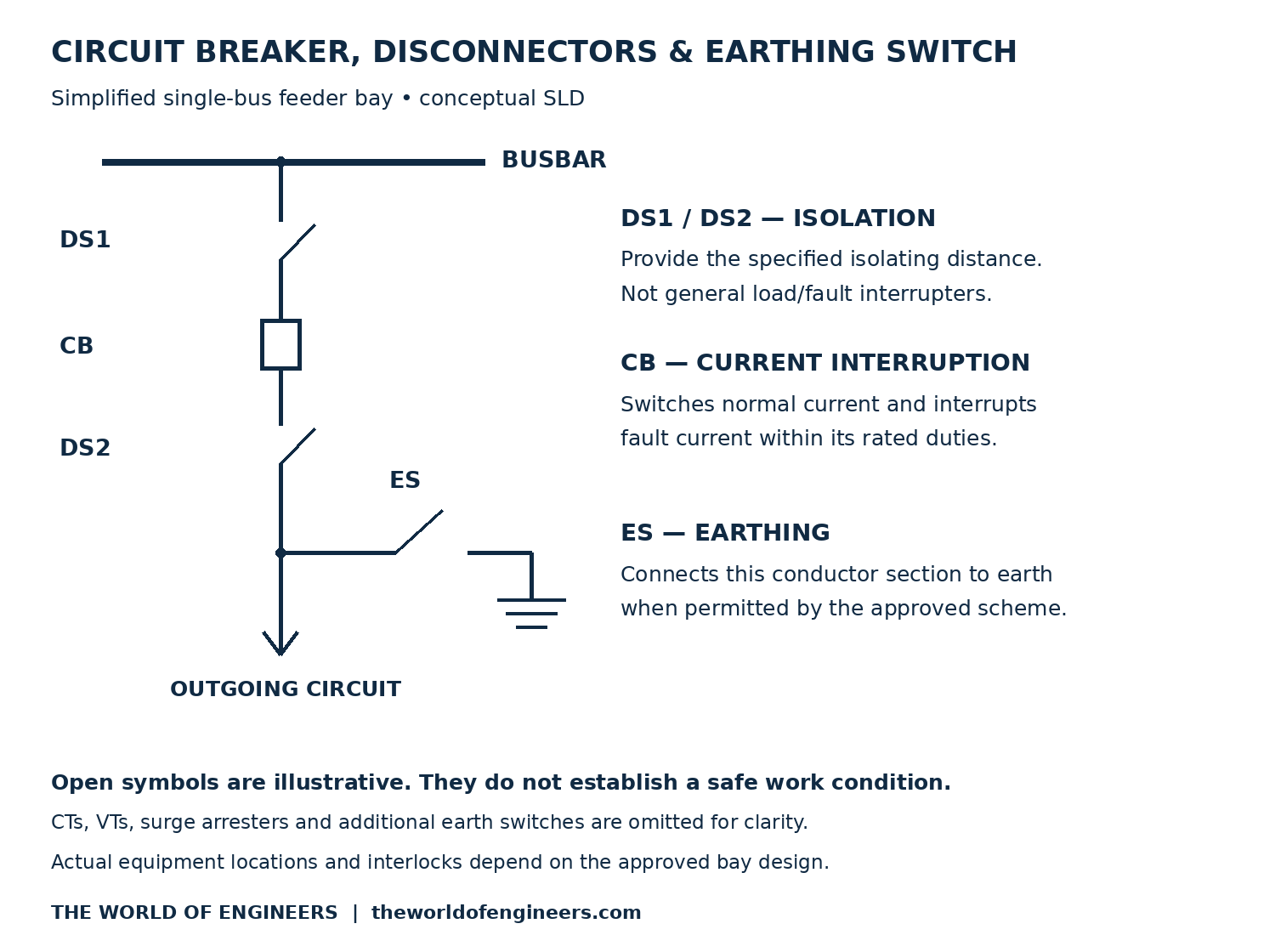
- DS1: the bus-side isolation point in this example.
- CB: the device assigned current-interruption duties.
- DS2: a second isolation point on the outgoing side of the CB.
- ES: connected to the outgoing conductor below DS2. It earths that connected section when closed.
Notice the ES branch. Closing it does not earth every part of the bay. An open DS2 separates the outgoing section from the CB-side conductor. Additional earthing provisions may therefore be needed for a different work zone.
Use the actual SLD to identify other sources, remote-end connections, parallel paths and the proposed work boundary. Continue with Reading a 115/13.8 kV Substation SLD for a broader drawing example.
1. Circuit breaker: interrupting current
A high-voltage CB has an interrupting system designed for specified switching duties. Its ratings cover more than the normal current. Rated voltage, insulation levels, short-circuit breaking current, making duty and operating sequence all matter.
A CB does not independently identify every fault. Protection relays and associated measurement circuits detect applicable conditions and issue trip commands. The trip circuit, DC supply and operating mechanism must then perform correctly.
An open conventional CB should not automatically be treated as an approved isolation boundary. Check whether the apparatus provides a separately specified disconnecting function.
2. Disconnector: establishing isolation
A disconnector provides the required isolating distance. In AIS, this is often a visible open gap. Typical arrangements include centre-break, double-break, vertical-break and pantograph designs. Selection also depends on layout, clearances and mechanical requirements. Siemens Energy’s disconnector overview illustrates these families.
Do not treat the device as a general load-break switch. However, saying that a disconnector can never switch any current is also misleading. Some designs have specified duties for small currents or conditions with limited voltage change across the contacts. Hitachi Energy’s disconnector applications describes this distinction.
Bus-transfer and bus-charging duties require appropriate ratings and an approved operating arrangement. IEC 62271-102 addresses these capabilities. A bus coupler being closed does not by itself authorize every disconnector operation.
3. Earthing switch: earthing a defined section
An ES connects its conductor node to earth. The location matters: a line-side ES, a bus-side ES and an ES beside a CB can serve different sections.
Some earthing switches have short-circuit making capability. Others have different assigned duties. A making rating does not turn the ES into a fault-interrupting circuit breaker or authorize deliberate closing onto an energized circuit.
Hitachi Energy’s integrated GIS application guide distinguishes maintenance earthing arrangements from fast-acting/make-proof earthing switches. Use the actual equipment rating rather than assuming all ES designs are equivalent.
Why are disconnectors supplied with one or two earth switches?
The number reflects the earthing points required by the bay design. A disconnector with two ES arrangements may provide separate earthing connections on opposite sides. A single ES serves its connected side. Confirm this on the manufacturer’s arrangement drawing and the project SLD.
Count the earthing functions and locations explicitly when reviewing a BOQ. Do not assume that “two earth switches” means two phases or that either arrangement earths the complete bay.
Practical interlocking examples
The following are design-review examples, not universal logic equations. Confirm permissives against the approved interlocking matrix and equipment capabilities.
| Interface | Typical review question |
|---|---|
| CB and DS | Does the logic prevent an unauthorized DS operation that would interrupt load current? |
| DS and ES | Does it prevent earthing a section that remains connected to an energized source? |
| ES and CB closing | Does it prevent energizing a section that is earthed through the relevant ES? |
| Double-bus transfer | Are any permitted overlapping bus-disconnector positions tied to the approved transfer arrangement and device ratings? |
| Position feedback | How does the logic handle intermediate, contradictory or missing indications? |
| Multiple supplies | Are remote-end supplies, backfeed and other energization paths included? |
Opening a breaker is not proof that every conductor is dead. Isolation, securing against reconnection, verification of absence of voltage and earthing must follow the site’s approved safety rules. Hitachi Energy’s disconnecting circuit-breaker guidance describes these distinct safety functions.
Interlocking should preserve required protective tripping. Do not describe “CB closing blocked” as “all CB operation blocked.” The approved design determines the closing permissives and trip behavior.
AIS vs GIS: the functions remain important
In AIS, you can often identify separate devices in the yard. In GIS, functions may be combined within an enclosure. A combined disconnector/earthing-switch arrangement still has distinct operating positions and duties. Hitachi Energy’s ELK-14 GIS overview is one example of combined functions.
A disconnecting circuit breaker (DCB) is another important exception: it combines CB and disconnector functionality in a specifically designed unit. Do not apply the limitations of a conventional breaker indiscriminately to a rated DCB.
Read your related 380 kV GIS guide and browse the Substation Design category.
A rating mistake to avoid in tender reviews
A kA figure does not always mean breaking capacity. A disconnector’s short-time withstand current specifies a different duty from a CB’s short-circuit breaking current. Hitachi Energy’s double-break disconnector data lists withstand ratings separately.
- Check equipment voltage and insulation requirements.
- Distinguish continuous current, short-time withstand, peak withstand, making and breaking duties.
- Specify the number and position of earthing switches.
- Confirm required motor drives, auxiliary supplies and position contacts.
- Identify special switching duties and required interlocks.
- Match equipment schedules to SLDs, layouts and the scope matrix.
Frequently asked questions
Are an isolator and a disconnector the same?
In common HV substation usage, isolator often means disconnector. Confirm the formal device designation and ratings. A load-break switch or switch-disconnector has additional assigned switching duties.
Does a CB replace a disconnector?
Not automatically. Conventional breakers and disconnectors have different functions. A properly specified DCB can combine both.
Can an earthing switch break fault current?
Do not assume it can. Short-circuit making capability and fault-breaking capability are different duties.
Is an open CB enough to close the ES?
No universal rule allows this. Establish the relevant isolation, voltage condition, source boundaries and approved permissives first.
Related practical guides
- Power Transformer Testing: Site Tests and Commissioning Checklist
- Panels Required in Substations
- Inside a 380 kV BSP: Overall Layout Drawing Explained
- 380 kV Substation Design Articles
Technical references
- IEC 62271-102 — AC disconnectors and earthing switches
- Siemens Energy — Disconnectors and earthing switches
- Siemens Energy — High-voltage circuit breakers
- Hitachi Energy — Disconnectors
- Hitachi Energy — Horizontal double-break disconnector
- Hitachi Energy — Disconnecting circuit breakers
- Hitachi Energy — Integrated GIS applications
- Hitachi Energy — ELK-14 GIS